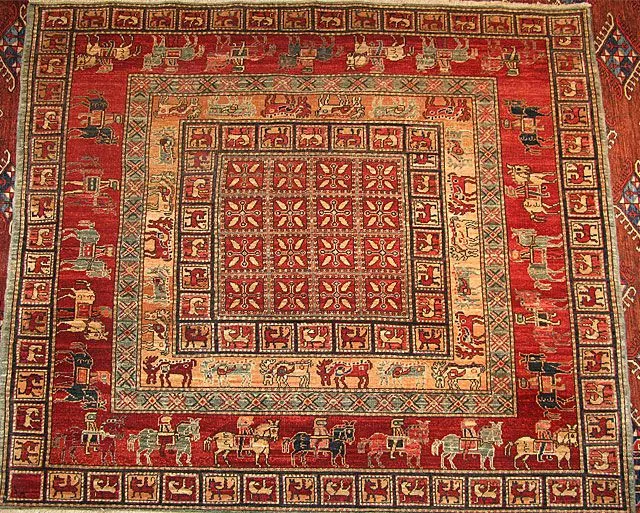
The world’s oldest existing rug ever obtained is a horse that, in 1327-1328, is at a point called “patic” at 80 kilometers of the external Mongolian border and 200 kilometers southeast of the “bisk” in a tomb belonging to the skate kings of ice between the Russian expert Professor Rodenko, a regional plumber in the mountains of the “Al and southern Siberian.” The rug, which has remained very good for the time of its texture to this day, is currently held at the Leninc Museum of the former Soviet Union in an empty air chamber. By 1950, in the Soviet Union, Professor Rodenko’s discoveries published a book in which the details of the rug were revealed. Professor Rodriguez believes that this carpet is the work of the people of the Great Khorasan. However, the discovery of the rug that was woven about 3,000 years ago shows the fact that the carpets industry has a history of more than fifty centuries in Iran. The “patic” rug profile is summarized as follows: dimensions: 6 phosphate and 8th in 6 prophecies equivalent to 210 x 183 centimeters. Plan: From its old age. Role: The outer part of a small repetitive stem from a legendary, winged beast, and then a row of rides, one among the standing on the horse, and one walking. A row of deer is found among the riders and the following, and men walking along with horses openly recall the role of the pillars of the Jamsss throne. Peres: The wool of the colors used: red, green, blue, orange, and a kind of blue-oriented green that is known as the patriarchy bell. Type of nodes: Symmetric (Turkish buff) the number of nodes in ten square centimeters: 3600 numbers used: horse cover.